
Although the government has not officially released the report submitted by the commission formed under the leadership of former judge Gauri Bahadur Karki, it has been made public through the media. The report accuses then-Prime Minister KP Sharma Oli, then-Home Minister Ramesh Lekhak, and then-Inspector General of Police Chandra Kuber Khapung of negligent and reckless actions.
While the inquiry commission regarding the incidents of September 8 and 9 recommended criminal prosecution against then-Prime Minister KP Sharma Oli, Home Minister Ramesh Lekhak, and then-Chief of Nepal Police Chandra Kuber Khapung, it did not specifically identify anyone as guilty in the incident of the 9th.
In the two days of protests, 76 people died across the country and more than 2,500 were injured. A total of 2,671 government, private and community buildings were vandalized or set on fire nationwide.
The report submitted by the commission led by former judge Gauri Bahadur Karki notes: “After Gen-Z protesters began losing their lives to police bullets, a state of reckless activity was observed as firing was not stopped for nearly four hours.”
The report recommends investigating and prosecuting them based on the offense under sub-section 1 of Section 181 and Section 182 of the National Penal Code, 2017.
If found guilty under the sections designated by the commission, then-Prime Minister KP Sharma Oli, Home Minister Ramesh Lekhak, and Inspector General of Police Chandra Kuber Khapung could face 3 to 10 years of imprisonment and a fine ranging from 30,000 to 100,000 rupees.
Similarly, the commission has recommended the investigation and prosecution of then-Home Secretary Gokarna Mani Duwadi, Kathmandu’s Chief District Officer Chhabilal Rijal, Inspector General of the Armed Police Force Raju Aryal, and Chief of the National Investigation Department Hut Raj Thapa under Section 182 of the National Penal Code for the offense of causing death through negligence. If found guilty, they could face up to 3 years of imprisonment and a fine of up to 30,000 rupees.
Regarding the current Inspector General of Police Dan Bahadur Karki, a recommendation for departmental action has been made in accordance with the Police Act and Regulations, citing that he issued orders that created a security vacuum and showed negligence regarding the security of weapons during the incident of the 9th.
AIG Siddhi Bikram Shah, DIG Om Bahadur Rana, DIG Bishwo Adhikari, SSP Dip Shamsher Rana, and SP Rishiram Kandel have also been recommended for departmental action for weaknesses in the performance of their duties.
The commission has recommended action against the then-Operation Commander of the Armed Police Force, AIG Narayan Datta Paudel, Armed Police Brigade Commander Suresh Kumar Shrestha, and SP Jiban KC, according to the Armed Police Force Act and Regulations.
Additionally, Joint Director of the National Investigation Department Krishna Prasad Khanal and Joint Investigation Director Reben Kumar Gachhadar have been recommended for action under the Nepal Special Service Act.
Recommendation for action against 4 army commanders
The commission has recommended action against four Nepal Army commanders, stating they failed to provide security at four critical locations where they were deployed.
Those recommended for action include Brigadier General Manoj Baidawar, commander of the Presidential Palace (Shital Niwas); Lieutenant Colonel Diwakar Khadka, commander of the Prime Minister’s Residence (Baluwatar); Lieutenant Colonel Ganesh Khadka, commander of Singha Durbar; and Major Santosh Dhungel, commander of the Parliament Building (New Baneshwor).
The commission has directed the government to initiate legal proceedings against them in accordance with Section 105, Sub-section 1, Clause (a) (7) of the Army Act, 2006. Section 105, Sub-section 1, Clause (a) (7) of the Army Act, 2006, specifies the issuance of a ‘reprimand’ as a penalty.
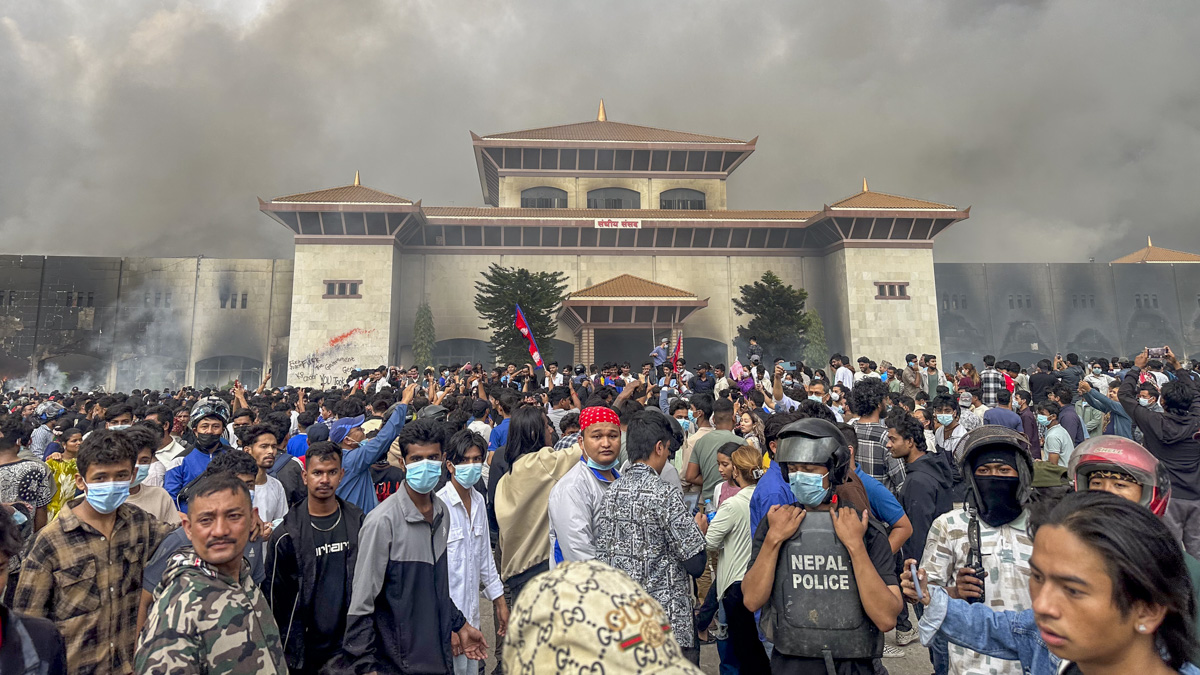
While the commission recommended action against the four individuals and concluded that the army failed to assist in stopping the protests on September 8 and 9, the report also includes details of how the army rescued high-profile individuals and moved them to safety, as well as the helicopter rescue of police officers trapped on the roof of the Maharajgunj Police Circle.
The commission writes in its report: “Had the Nepal Army not been deployed from 10:00 PM on September 9, not only would there have been even greater loss of life and property across the country on September 10, but the very existence of the nation could have been in peril. There has been widespread praise for the Nepal Army’s role in saving the nation.”
Use of lethal weapons by security forces
According to the report, 76 people died and 2,522 were injured during the protests. The commission’s report mentions that among the deceased, 51 individuals sustained gunshot wounds. Based on the bullet samples extracted from the bodies of the injured and the deceased, the commission stated that lethal weapons were indeed used by security forces.
“In the public area in front of the Federal Parliament Building, not only was celebratory fire (blank fire) used, but actual lethal metal bullets were also fired,” the report states. “Evidence confirms that while rubber bullets should have been prioritized during the use of force, weapons such as INSAS and SMG (Submachine Guns) were used extensively instead.”
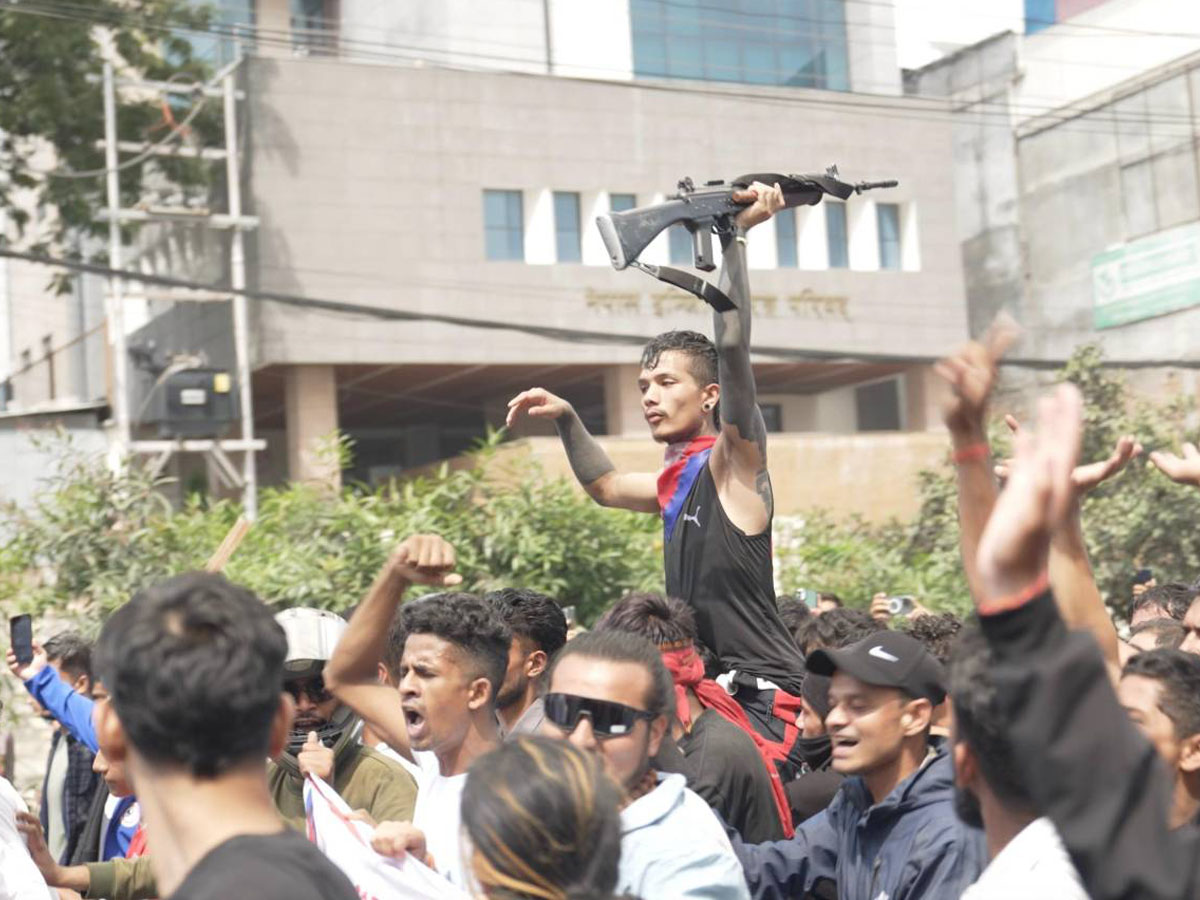
Post-mortem examinations were conducted on 63 of the deceased. Among them, 48 had sustained gunshot wounds. Of those, 20 were shot in the chest, 14 in the head, 5 in the neck, and 4 in the stomach. One person each was shot in the buttocks, lungs, chest and neck (combined), shoulder, and thigh. On September 8, 17 people were shot and killed in front of the Parliament Building in Baneshwor.
The commission noted in its report that security personnel fired indiscriminately even when there was no direct threat to them. “The fact that protesters themselves removed the doctor and armed police personnel from an Armed Police Force ambulance and escorted them from the south gate of the Federal Parliament Building to the main gate within the complex to let them inside indicates there is no basis to believe there was an imminent threat to the security personnel around the premises,” states page 650 of the report.
Corruption and misgovernance, causes of the protest
The commission has pointed out that corruption and misgovernance were the primary causes of the movement. The report mentions that political factors such as the repetition of the same political leadership, power-sharing deals within political parties, and the neglect of public expectations, created a sense of rebellion among the younger generation.
The report concludes that while the ban on social media provided immediate energy to the movement, the underlying causes were years of corruption, misgovernance, unemployment and extreme dissatisfaction with the political leadership.
Regarding the violent protests of September 9, the commission concluded they were a reaction to the suppression on the 8th. The report states, “The anger generated by the events of the 8th led to incidents of vandalism, arson and looting across the country on September 9."
Perpetrators involved in vandalism and arson of the 9th could not be identified
Although the commission’s official name is the “Inquiry Commission Regarding the Incidents of September 8 and 9,” it has not held any specific individuals responsible for the events of September 9.
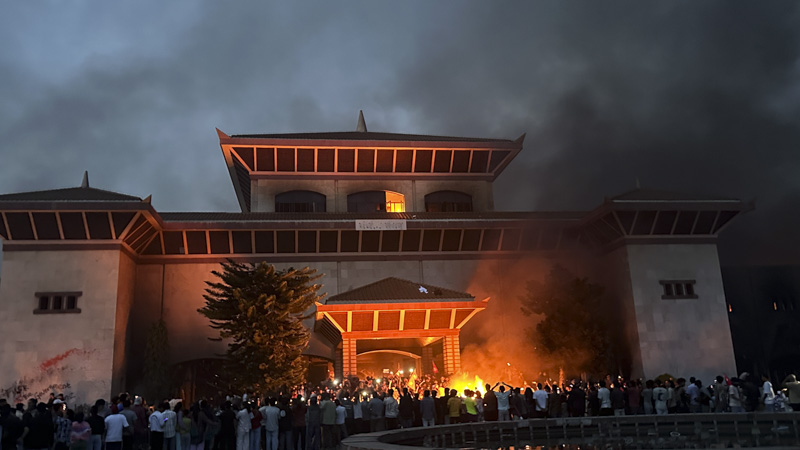
During the violent protests that began early on the morning of September 9, a total of 2,671 government, private and community buildings, including the Parliament Building, the Presidential Palace, Singha Durbar, and the Supreme Court, were vandalized or set on fire across the country.
The commission’s report mentions that all incidents on September 9 must be investigated comprehensively one by one. The report states: “Regarding the individuals involved in the events of September 9, based on the investigation so far, it has not been possible to collect concrete evidence sufficient to recommend prosecution.”
The commission avoided reaching a conclusion by stating that no intelligence reports from government or non-governmental agencies have been received to assist in the matter. The report says: “As the commission’s mandate was for a fixed and short duration, the commission was unable to investigate the nationwide incidents in detail or prove anyone guilty at this time due to a lack of time and manpower.”
However, the commission considers the collection of BTS (Base Transceiver Station) data from telephone towers at the specific locations, including the Federal Parliament Building, Singha Durbar, the Presidential Palace, the Supreme Court, private commercial establishments, and various party offices, at the time of the incidents on the 9th to be a significant achievement.
The commission’s report states that it requested and included the location-based telephone numbers of individuals physically present during the arson and vandalism from Nepal Telecom and Ncell.
The commission has collected 22,496 mobile numbers of individuals involved in the arson and vandalism of the Parliament Building.
Additionally, it collected and submitted to the government the mobile numbers of at least 2,692 individuals at Singha Durbar, 1,417 at the Supreme Court, 5,360 at Nakkhu Jail, and 2,644 at the Presidential Palace. The report states: “It is now necessary for the government to form an investigation team including experts to conduct a detailed investigation to reach the accused by examining other available evidence, such as CCTV footage and social media.”
Report without forensic evidence
Although the forensic report from the Indian laboratory confirmed that petroleum products were used to set fire to Singha Durbar, the Supreme Court, and the Parliament Building, there is no mention of this in the commission’s report.
The Nepal Investigative Multimedia Journalism Network (NIMJN) has already published an investigative story regarding the forensic tests conducted in India, which found that petroleum products were used in the arson.
Protesters throwing petrol bombs at the Parliament Building on September 9. This photo was taken from a video found on social media.
However, the commission has only expressed suspicion that lethal chemicals rather than just ordinary petrol were used during the arson. The report points out that Discord conversations included 356 mentions of bombs made using petrol and cloth in bottles, and that formulas for creating Sodium metal and Napalm were exchanged.
Furthermore, the rapid spread of fire at the Parliament Building and other structures merely suggested the possible use of highly flammable chemicals like Sodium or Magnesium.
The testing report provided by the Indian government to Nepal mentions that only petroleum products were used. The commission did not include that specific report in its own findings.
Lack of coordination between police and army
The report highlights serious deficiencies in coordination between the Nepal Police and the Nepal Army. It points out that after the situation in front of the Federal Parliament Building became tense on September 8, the administration requested army assistance, however, the failure to arrive on time resulted in significant damage.
Army officials stated that their arrival in Baneshwor was delayed because protesters obstructed the roads by lying under the wheels of trucks. The army only entered the Parliament Building premises around 3:00 PM, by which time the police had already employed lethal force.
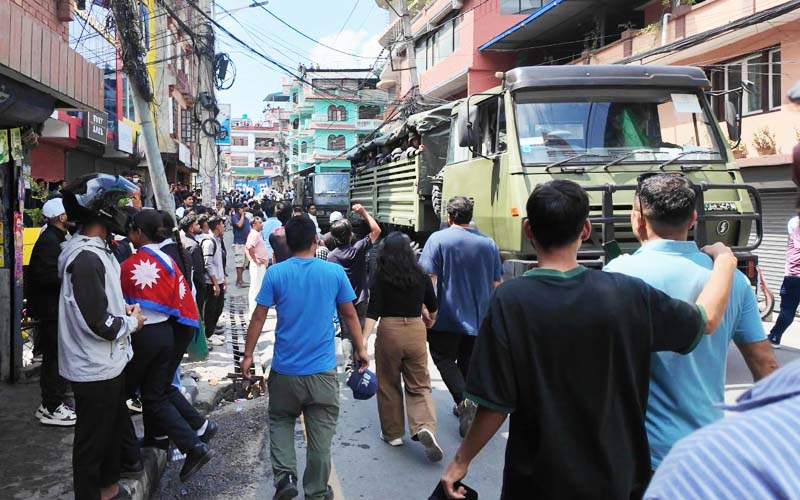
The commission stated that during the arson and vandalism in various parts of the country on September 9, there was a visible lack of an integrated command among the security agencies. The report mentions that when the police left their units to move elsewhere, a ‘tactical withdrawal’ occurred, creating a vacuum in the state’s presence.
Similarly, the report notes that although the army was deployed at sensitive sites like Singha Durbar and Shital Niwas, they failed to offer effective resistance and remained mere spectators when protesters entered.
“The Chief District Officer of Kathmandu stated that after the curfew was issued, he expected the army to provide support and strengthen the security situation, but such assistance was not provided,” the report says. “Despite correspondence being sent at 12:00 PM on the 8th requesting army assistance as the situation was spiraling out of control, it appears that the Nepal Army’s support was not obtained.”
The commission concluded that during the events of September 8 and 9, security agencies operated under their own separate chains of command, leading to a lack of coordination and a security vacuum. Practical difficulties in joint deployment arose because various security agencies have their own distinct weapons, equipment and rules of engagement.
The commission has suggested that a single command would ensure a clear, uniform procedure and protocol for all agencies. It argues that security would be more robust and effective if the overall responsibility for ultra-sensitive areas such as the Federal Parliament Building, the President’s Residence, and the Prime Minister’s Residence were assigned to a single agency.
Cover photo: Singha Durbar after the arson on September 9 during the Gen-Z movement. Photo: Barsha Shah/NIMJN
Please adhere to our republishing policy if you'd like to republish this story. You can find the guidelines here.
Comments